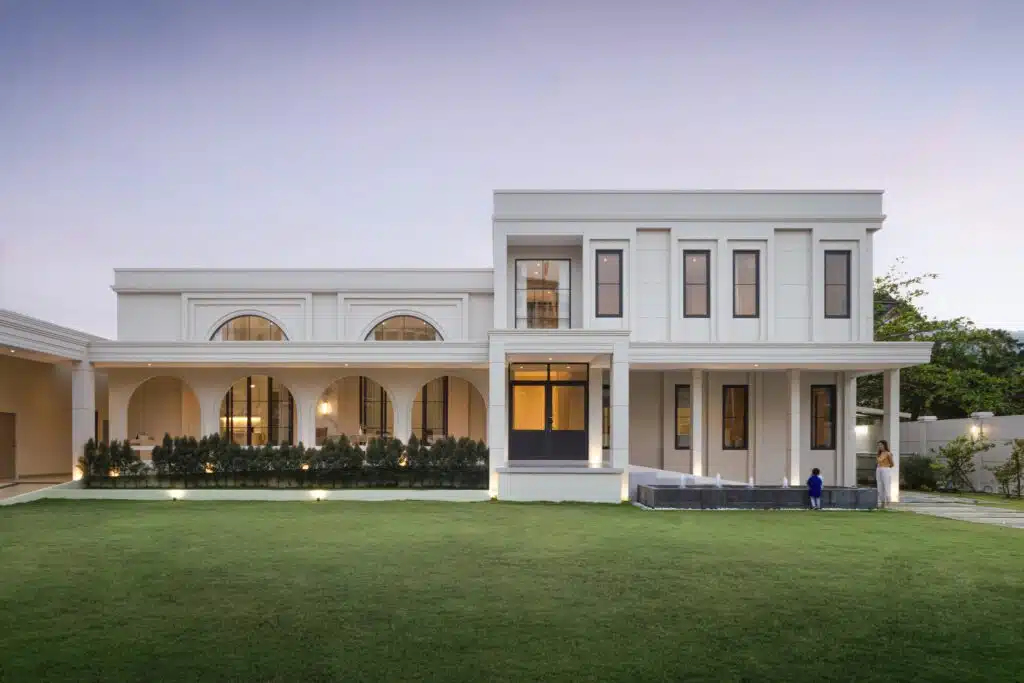


BEAUX – ARTS HOUSE
Chiang Mai, Thailand
Project name : BEAUX – ARTS HOUSE
Company name : S.O.S Architects
Location : Chiang Mai, Thailand
Building Type : Residence
Completion Year : 2024
Area : 670 sq.m
Lead Architect : Tawanshine Intarachit, Alongkot Paophanit
Lead Interior : Tawanshine Intarachit, Dissaraporn Saechen
Structure Engineer : Thunyawat Chaichompoo
Construction consultant : Anucha Nanekrungson
Owner : Khun Worapan Supagornmongkol, Thantaporn Supagornmongkol
Photographer credits : Pongkun Chueysakun, photo.viss
บ้านสไตล์ Beaux-Arts (โบซาร์) คือรูปแบบสถาปัตยกรรมที่มีต้นกำเนิดจาก École des Beaux-Arts ในกรุงปารีส ประเทศฝรั่งเศส ซึ่งได้รับความนิยมอย่างสูงในช่วงปลายศตวรรษที่ 19 ถึงต้นศตวรรษที่ 20 สไตล์นี้ผสมผสานองค์ประกอบจากสถาปัตยกรรมคลาสสิกของกรีกและโรมัน เข้ากับอิทธิพลของยุคฟื้นฟูศิลปวิทยาและบาโรก เน้นความสมมาตร ความโอ่อ่า และรายละเอียดที่หรูหรา
บ้านหลังนี้ การออกแบบที่เน้นความสมมาตรและความโอ่อ่า ถูกจัดวางพื้นที่ภายในอย่างมีลำดับชั้น เช่น ห้องรับแขกขนาดใหญ่ เชื่อมกับโต๊ะทานอาหาร และโซนเตรียมอาหาร เป็นพื้นที่ใช้บ่อยที่สุดของบ้าน
มีลานกว้างและทางเดินรอบบ้าน เพื่อออกกำลังกาย เดิน – วิ่ง ได้รอบบ้าน ออกแบบทางลาด (Ramp) คำนึงถึงผู้สูงอายุ และให้ความสำคัญเรื่องทิศทางของแสงแดดและลม ผนังสองชั้นในส่วนที่โดนแดดโดยตรง เพื่อป้องกันความร้อน จัดวางห้องน้ำให้อยู่ในส่วนที่แสงแดดเข้าถึง
ในส่วนของงานตกแต่งภายใน ใช้ Arch โค้งเข้ามาเพิ่มจุดเด่นในโถงนั่งเล่น ที่เชื่อมต่อกับโต๊ะทานอาหารและต่อเนื่องมาจากพื้นที่นั่งเล่นนอกบ้าน งานบัวผนังตกแต่งต่อเนื่องไปกับเส้นทองเหลืองของพื้นหินขัด (Terrazzo) การใช้วัสดุหรูหรา เช่น หินอ่อน หินปูน การตกแต่งด้วยปูนปั้น บัวตกแต่งผนัง เลือกใช้สีส่วาง ดูโปร่ง สบายตาและวัสดุที่ดูแลรักษาง่าย
The Beaux-Arts residence draws its inspiration from the École des Beaux-Arts in Paris, France—a movement that reached its height between the late 19th and early 20th centuries. Characterized by classical Greek and Roman elements, blended with Renaissance and Baroque influences, the style is defined by its emphasis on symmetry, axial planning, monumentality, and refined ornamentation.
This residence exemplifies those principles through a composition that prioritizes symmetry and spatial hierarchy. The main living hall—a voluminous space designed for both reception and leisure—forms the central axis of the home, seamlessly connected to the dining area and a secondary food preparation zone. These interlinked spaces serve as the primary locus of daily activity and interaction.
The architecture integrates a landscaped courtyard and a perimeter walkway, accommodating both leisure and physical activity such as walking and jogging. Accessibility is a key consideration: a gently sloped ramp has been incorporated to support aging residents and ensure universal access throughout the property. Environmental responsiveness is also embedded in the design, with solar orientation and wind flow carefully studied. Dual-layered wall assemblies are employed on sun-exposed façades to mitigate heat gain, while bathrooms are strategically located to maximize access to natural light.
Interior detailing reflects the Beaux-Arts emphasis on craftsmanship and material richness. A series of arched openings define and frame the transition between the indoor living spaces and the adjacent outdoor sitting area, creating a sense of continuity. Decorative wall mouldings extend vertically and horizontally, harmonizing with brass inlays embedded within terrazzo flooring. High-end finishes—such as marble, limestone, and ornamental plasterwork—are selected not only for their aesthetic value but also for durability and ease of maintenance. The overall palette remains light and refined, enhancing spatial clarity and visual comfort.